👋 Day 1 – Activity 2: Basic German Greetings & Introductions ✨
Time to turn letters into conversations! In this lesson you’ll master greetings, polite phrases, and self-introductions. You’ll also learn when to use du (informal “you”) vs. Sie (formal “you”) — a key cultural skill in German-speaking countries. 🇩🇪
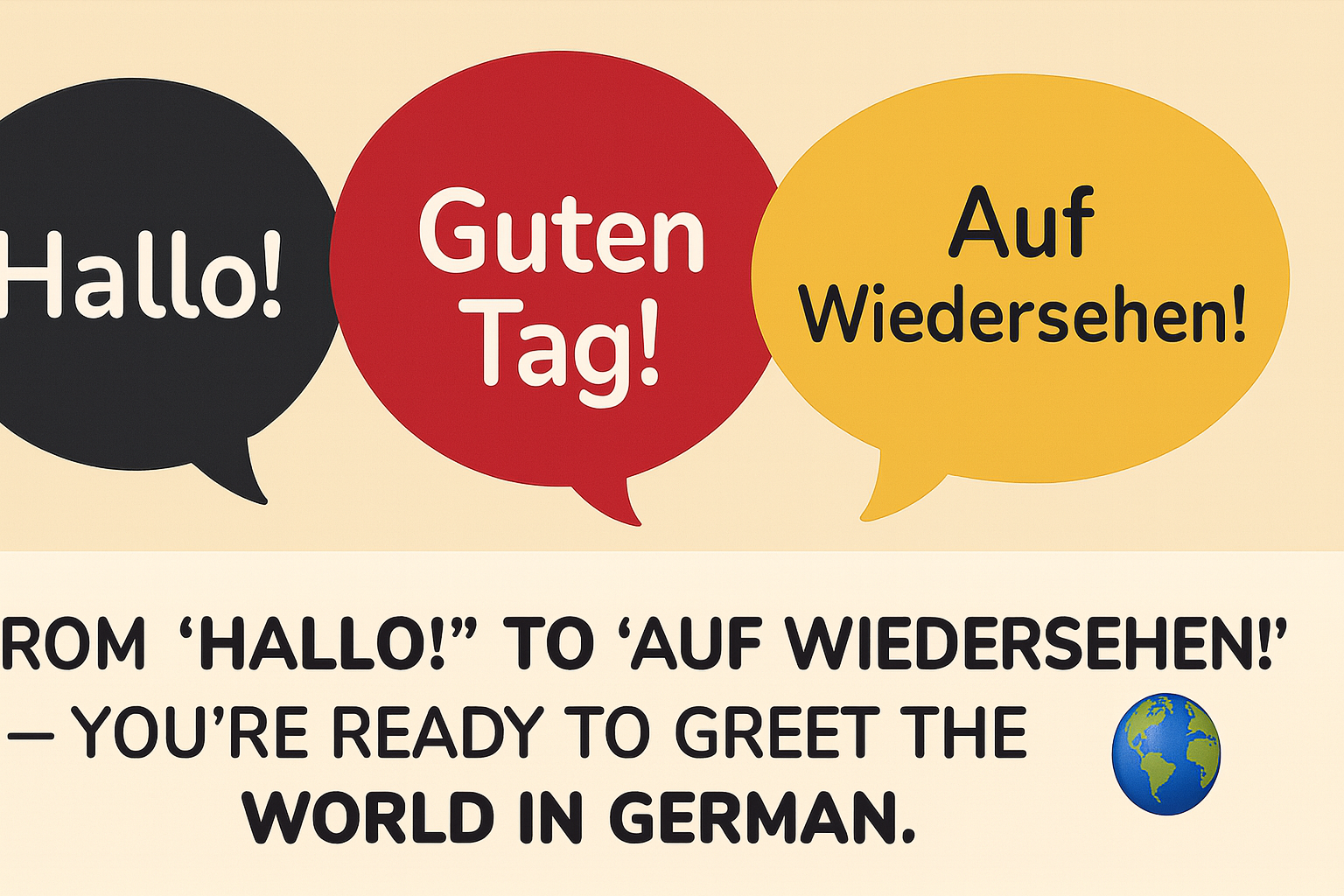
💬 Must-Know German Greetings
Start with these friendly, natural greetings. Notice how some are time-based and others work all day.
| German | Meaning | Usage | Notes |
|---|---|---|---|
| Hallo! | Hello! | Anytime | Casual; safe everywhere |
| Guten Morgen! | Good morning! | Until ~10–11 AM | Polite; use at work/school |
| Guten Tag! | Good day! | Late morning to early evening | Neutral; formal contexts |
| Guten Abend! | Good evening! | After ~6 PM | Polite |
| Gute Nacht! | Good night! | Before sleeping | Not a greeting when arriving |
| Wie geht’s? | How’s it going? | Informal | Short for Wie geht es dir? |
| Wie geht es Ihnen? | How are you? (formal) | Formal / respectful | Use with strangers, seniors |
| Auf Wiedersehen! | Goodbye! | Formal | Phone: Auf Wiederhören! |
| Tschüss! | Bye! | Informal | Very common, friendly |
| Bis später! / Bis bald! | See you later! / soon! | Informal | Friends/colleagues |
🙏 Polite Words That Open Doors
| German | Meaning | Context |
|---|---|---|
| Danke / Vielen Dank | Thanks / Many thanks | Use everywhere |
| Bitte | Please / You’re welcome | Multi-purpose magic word ✨ |
| Entschuldigung | Sorry / Excuse me | Getting attention / apologizing |
| Kein Problem! | No problem! | Casual reply to thanks |
🪪 Introducing Yourself (Formal & Informal)
Choose du with friends, classmates, and children. Use Sie with older people, strangers, or in business settings. If unsure, start with Sie — it’s respectful.
👥 Informal (du)
- Ich heiße … — My name is …
- Ich bin … — I am …
- Ich komme aus Indien. — I’m from India.
- Ich wohne in … — I live in …
- Freut mich! — Nice to meet you!
🧑💼 Formal (Sie)
- Wie heißen Sie? — What’s your name?
- Ich heiße … — My name is …
- Woher kommen Sie? — Where are you from?
- Ich komme aus Indien.
- Angenehm, Sie kennenzulernen. — Pleased to meet you.
🎭 Mini Dialogues (Practice Aloud)
1) At a language class (informal)
A: Hallo! Ich bin Asha. Und du?
B: Hallo Asha! Ich heiße Rahul. Freut mich!
A: Woher kommst du?
B: Ich komme aus Delhi. Und du?
A: Ich komme aus Mumbai.
2) At a reception (formal)
A: Guten Tag! Wie heißen Sie?
B: Guten Tag! Ich heiße Meera Sharma.
A: Woher kommen Sie, Frau Sharma?
B: Ich komme aus Indien. Angenehm!
🎙️ Pronunciation Focus
- Wie (how) → sounds like “vee”.
- Ich → soft “ch” (like a hiss). Not “ik”.
- Guten → the “u” is short; the “t” is clear.
- Tschüss → “choos” (long “ü” + double “s”).
🌍 Culture: Formality Matters
Germany values polite distance when meeting new people. Use Sie until invited to say du. In companies, first names + Sie is common: “Meera, könnten Sie bitte …?” ✔️
🧠 Exercises
- (du/Sie) Wie heißen ___?
- (du/Sie) Woher kommen ___?
- (du/Sie) Wie geht es ___?
🗝️ Answers
1) Sie — Wie heißen Sie?
2) Sie — Woher kommen Sie?
3) Ihnen — Wie geht es Ihnen? (formal) / Wie geht’s? (informal)
Hallo! Ich ____ Rahul. Ich ____ aus Jaipur. Und du?
🗝️ Answer
Hallo! Ich heiße Rahul. Ich komme aus Jaipur.
Wie heißt du? Woher kommst du?
🗝️ Answer
Wie heißen Sie? Woher kommen Sie?
✅ Recap & Next Steps
- You can greet people naturally in different contexts (morning, evening, casual, formal).
- You can introduce yourself and ask for someone’s name — with du and Sie.
- You know polite essentials: Danke, Bitte, Entschuldigung.
Next: build your numbers and time phrases in Day 2 — you’ll start describing your world in German! 🔢⏰